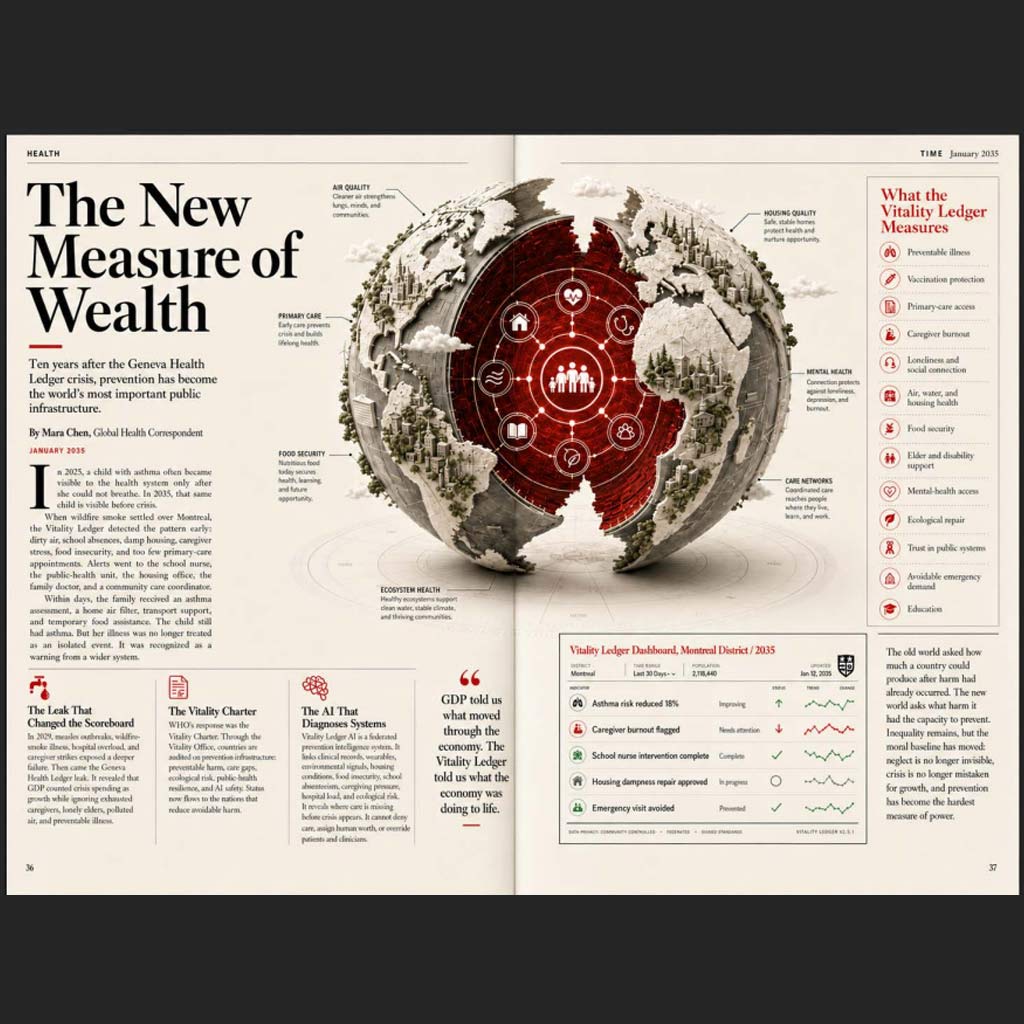
By 2035, the world has rewritten the meaning of power and wealth. Nations are no longer judged only by what they produce, extract, or defend, but by how well they prevent harm and protect the conditions for vitality. GDP has expanded to include health, education, caregiving, ecological repair, and quality of life. In this world, prevention is progress: the strongest countries are those that keep people and ecosystems well before a crisis begins.
Transformative technology
Vitality Ledger AI: federated prevention intelligence for health, care, and ecology.
Vitality Ledger AI links local health data, clinical records, wearables, air, water, food, housing, care, and loneliness signals without centralizing ownership. It detects early stress across bodies and communities so public systems can fund prevention before hospitals become the only option.
What kind of AI exists in your world?
Vitality Ledger AI is Tool AI that forecasts risk, reveals patterns, explains drivers, recommends care pathways, audits inequity. It cannot deny care, rank people, or override human choice. It is built by public-health systems, universities, community data trusts, Indigenous data-sovereignty bodies, and regulated firms under WHO-certified standards. It is not built by one institution, or one dominant worldview. Its ethical and cultural architecture is shaped by a global care council.
New or Reformed Institution
The purpose of WHO shifted from a policy-setting to a global health governance institution centered on preventative care. The WHO Vitality Office, certifies national Vitality Ledger systems, audits privacy, safety, bias, and equity, publishes prevention gaps, and coordinates financing for prevention infrastructure. It does not control national health systems; it makes neglect visible and standards enforceable. Enabling nations to coordinate around the conditions that keep people and planet well.
Transformed Sector
Health
Healthcare has shifted from sick‑care to an interconnected prevention. Health is a public responsibility, measured by conditions that let people and ecosystems flourish. Systems are funded and evaluated by preventable harm reduced, not treatment volume alone. Clinics still matter, but clean air, food security, housing, elder care, mental-health, education, and ecological repair are recognized as health infrastructure. Inequities remain, but are public, measured, and politically harder to ignore.
A Major Crisis Overcome
In 2029, overlapping measles outbreaks, wildfire-smoke illness, hospital overload, and caregiver strikes exposed a deeper failure: AI wealth had flowed into biotech and longevity while basic public-health systems, care work, and ecological protection eroded. Children paid first. WHO survived by accepting the Vitality Charter: nations would be judged by preventable harm reduced and monetizing breakdown of healthcare became less socially acceptable and politically risky.