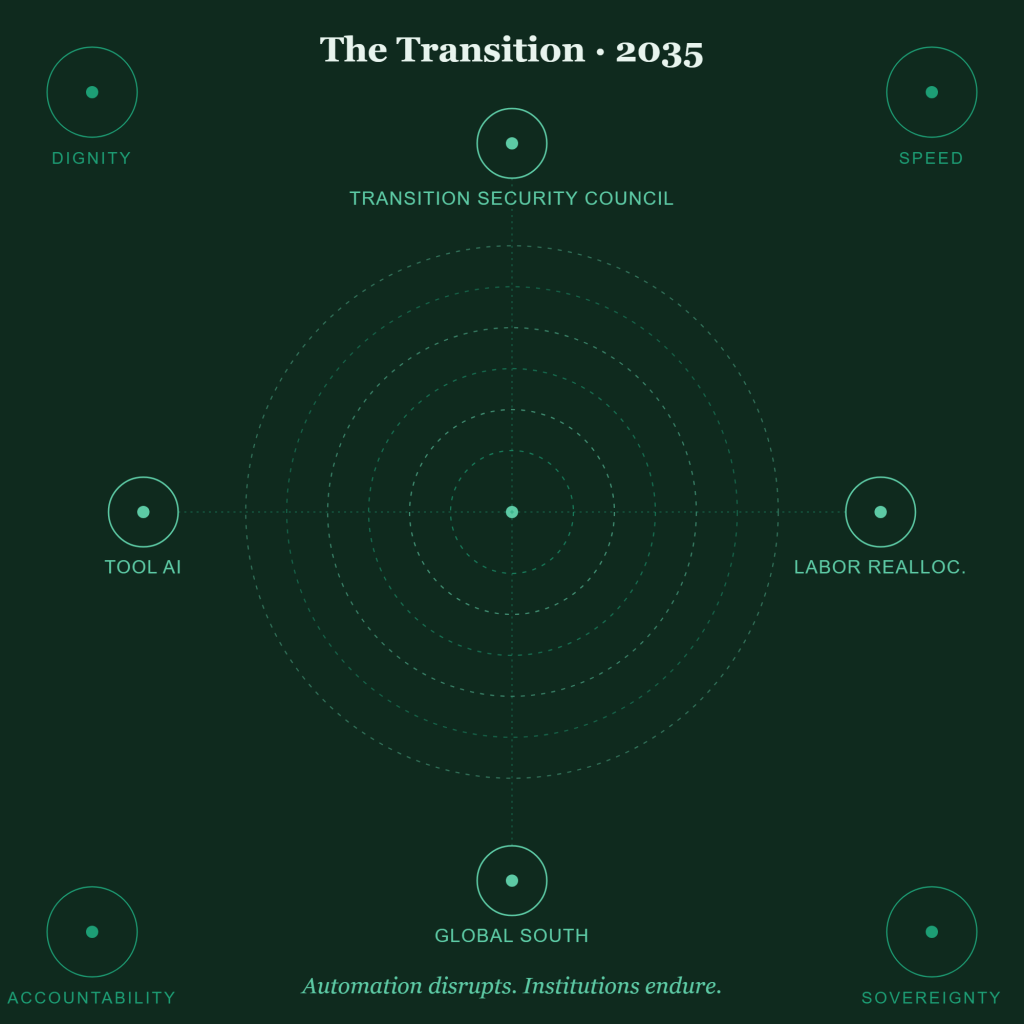
A world where automation displaces jobs but not people. By 2035, a new generation of institutions moves as fast as the technology disrupting them, giving workers real transition rights, income support, and pathways forward. The social contract didn’t break. It got rebuilt, unevenly and imperfectly, but it held.
Transformative technology
Distributed Labor Reallocation Platforms
AI-powered public infrastructure that matches displaced workers to retraining and new economic pathways in real time. Instead of years in bureaucratic limbo, a displaced worker gets a personalized pathway within weeks. Transition stops meaning abandonment.
What kind of AI exists in your world?
Tool AI only. AI handles forecasting, matching, and analysis at scale. It predicts which sectors shed jobs 12 to 24 months out and flags the most exposed communities. But every policy and allocation decision is made by democratically accountable institutions. Autonomous AI is excluded from any function that directly affects individual livelihoods. Private tech builds the tools. Governments own the decisions.
New or Reformed Institution
The Transition Security Council. A national-level body with an independent mandate, worker representation, and binding authority to deploy support before displacement peaks, not after. Funded by a levy on automation gains. It sits outside both the labor and finance ministries, reporting to the head of government. By 2035, versions of it exist in over 40 countries, mostly in the Global South.
Transformed Sector
Public Labor Administration
What was once a slow, form-heavy bureaucracy becomes a real-time, proactive system. Instead of managing unemployment after it happens, it anticipates displacement and moves first. Average time from job loss to reallocation drops from over three years to under eight months in participating countries. For workers in Southeast Asia and Sub-Saharan Africa, this is the difference between poverty and a second chance.
A Major Crisis Overcome
The 2030 Southeast Asia automation shock displaced four million manufacturing workers in under two years. Existing safety nets collapsed. A coalition of ASEAN governments launched the first Transition Security Framework as a regional emergency response. It was messy and politically contested. But it worked well enough to become the global template. The crisis didn’t get solved cleanly. It got survived well enough to learn from.