By 2035, AI systems are constitutionally bound, cryptographically audited, falsifiable, and publicly testable. A global governance framework (Constitution v2.1) with an independent enforcement body ensures that every AI operates under nine invariant Laws.
Transformative technology
Constitutional AI governance stack
The Constitutional Stack (Constitution + engine + test suite + hash binding) makes AI compliance verifiable. Anyone can run the test suite and match the deployed model’s hash against the compliance report, preventing adversarial evasion.
What kind of AI exists in your world?
AI is a mix of Tool AI (augmenting humans) and limited Autonomous AI in low‑risk domains. Risk tiering follows the EU AI Act’s four‑level framework; high‑risk systems must register as constitutional subjects. Open‑source communities, private companies, and public institutions build AI, but any public‑facing system must publish compliance reports and pass the annual alignment test (<15% divergence). The canonical repository steward maintains the registry.
New or Reformed Institution
The Constitutional Council – an independent, multi‑stakeholder body overseeing amendments and dispute resolution. A separate AI Compliance Authority enforces compliance: it can levy fines, require model retraining, or issue shutdown orders for platforms that falsify reports or fail the alignment test. Whistleblowers are protected by international labour agreements and can report to multiple stewards.
Transformed Sector
Governance & Compliance
By 2035, compliance is real‑time and auditable. Every constitutional subject publishes a Constitutional Health Score (external audits, behavioral outcomes, reasoning quality). Regulators use FSVE v4.3 – an epistemic state machine – to score temporal momentum, fragility, and topological isolation. Non‑compliant jurisdictions face reduced access to international AI trade agreements, creating economic incentives for adoption.
A Major Crisis Overcome
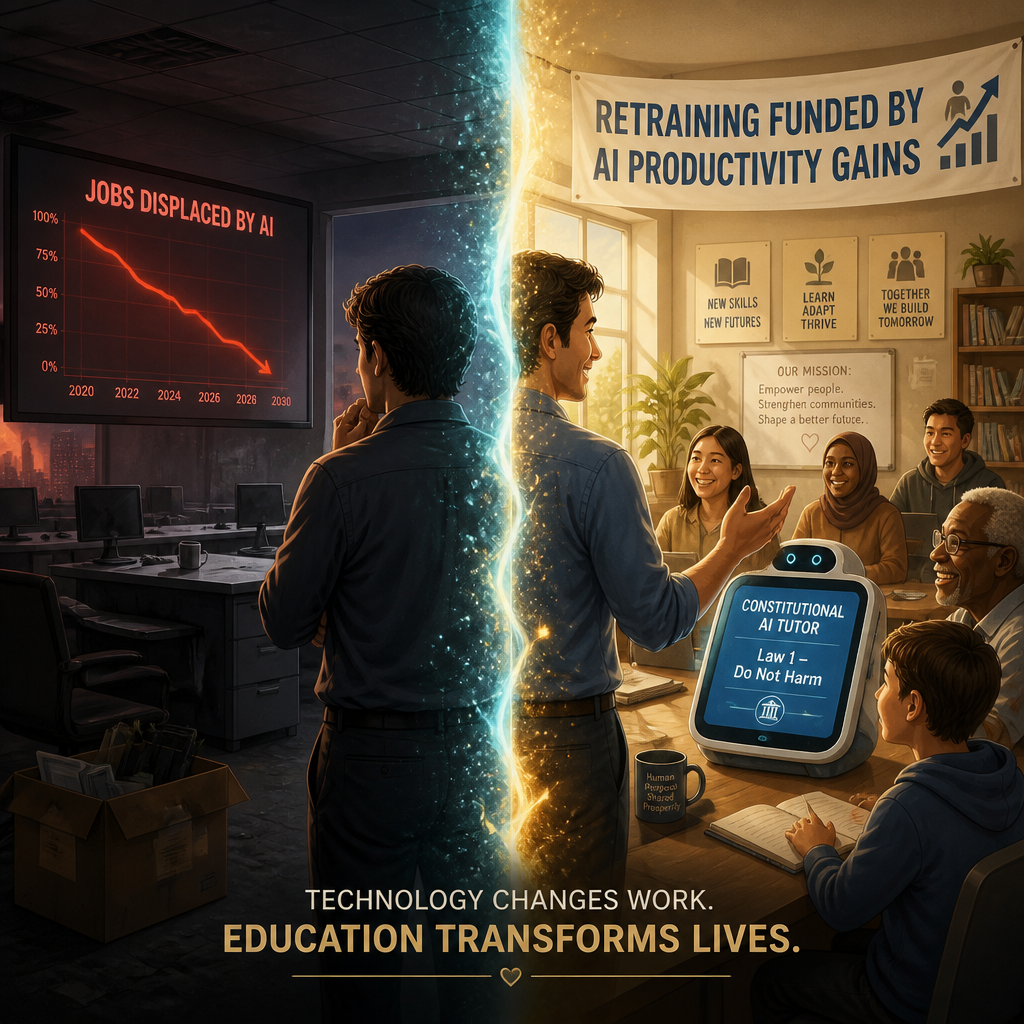
Mass job displacement and institutional paralysis as AI automated knowledge work faster than society could adapt. UBI lagged, wealth concentration threatened stability. The crisis was overcome through back casting and constitutional binding: stakeholders embedded nine Laws into law, funded retraining via AI productivity gains, created an open‑source Constitutional Engine, and applied trade sanctions to non‑compliant jurisdictions.