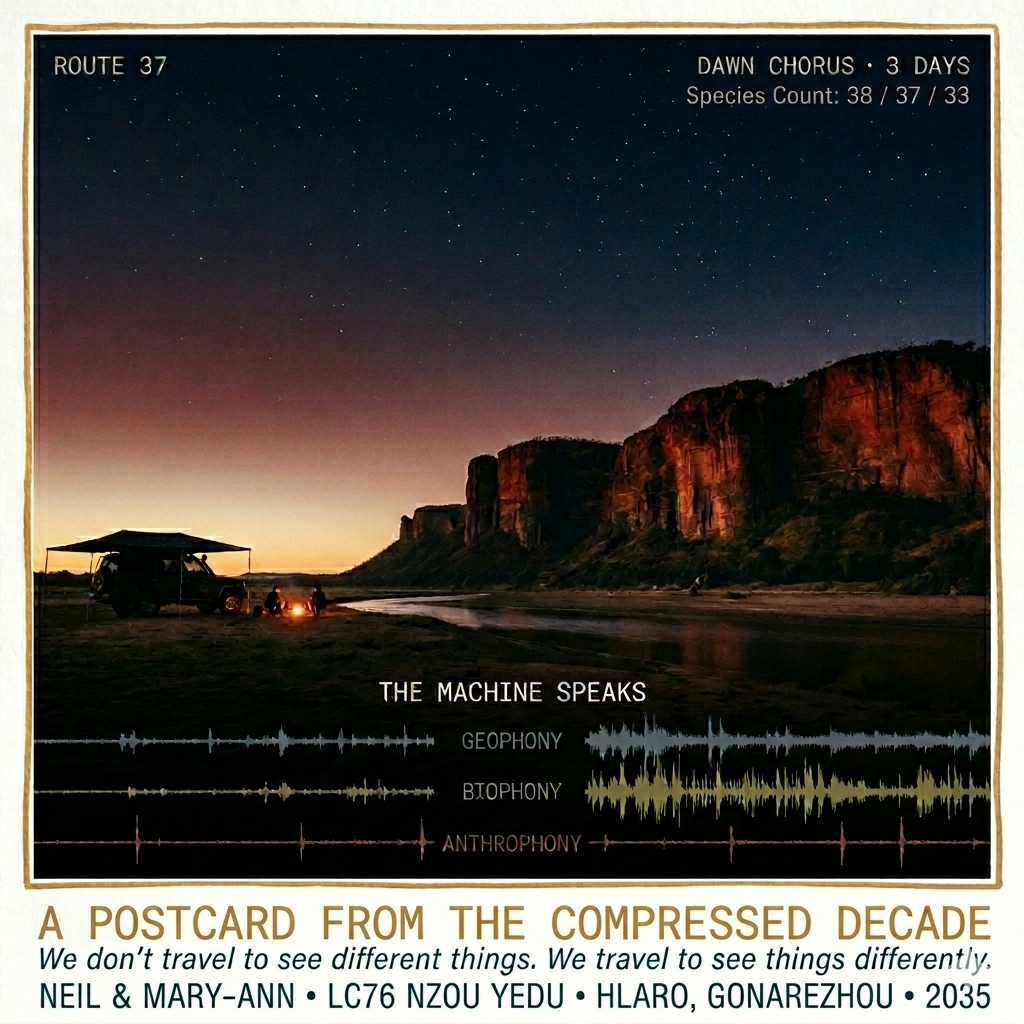
In 2035, AI has compressed a century of scientific progress into a decade — curing sickle cell, and enabling acoustic ecology that reads landscapes as living texts. The hope lies not in the technology itself but in the institutions built around it: community data sovereignty, conservation trusts that pay land custodians, and Off-Spectrum treaties protecting wilderness from optimisation. Read the field report from the compressed decade https://overlandslabs.github.io/Worldbuilding-AI-Futures/
Transformative technology
The Listening Machine — an edge-based acoustic world model for ecological perception
It solves ecological illegibility — the inability to know whether a landscape is healthy or silently declining. By 2035, a chip drawing four watts reads soundscapes in real time, carrying ecological baselines that reveal change across seasons. It deepens human attention rather than replacing it.
What kind of AI exists in your world?
Tool AI, edge-based, under human direction that runs locally on a vehicle-mounted chip — no cloud dependency, no continuous data extraction. It is multi-domain (medical diagnostics, ecological monitoring, multilingual translation) but deferential: it speaks only when asked. The same hardware powers two products – one that extracts data for the content economy, one that deepens presence. The institutions of 2035 exist to enforce the distinction.
New or Reformed Institution
The Conservation Acoustic Trusts — community-governed structures that flow real revenue back to land custodians from travellers’ use of acoustic monitoring systems. They align economic incentives with ecological health, give communities decision-making authority over their own data, and function as political spaces where people deliberate together on shared inheritance. Supported by the Indigenous Data Sovereignty Registry and Off-Spectrum Treaties protecting unmeasured wilderness.
Transformed Sector
Conservation
By 2035, Southern Africa’s conservancies are the most acoustically monitored ecosystems on earth. AI-powered arrays detect poaching, track species health through dawn-chorus baselines, and generate income for communities through data labour. The transformation matters because it reversed the colonial pattern: ecological data now belongs to the people who live with the ecology, not to foreign platforms. Where the trusts operate, conservation revenue reaches the communities who maintain the land.
A Major Crisis Overcome
The Player Piano crisis: between 2027 and 2032, AI displaced the knowledge-working middle class across professions — auditors, lawyers, analysts, journalists. The world overcame it partially through UBI pilots, partially through new economic structures like conservation data labour and attentional travel, and most fundamentally by building institutions that created meaningful work in embodied, relational domains where human presence remains irreplaceable. The crisis is not fully resolved.