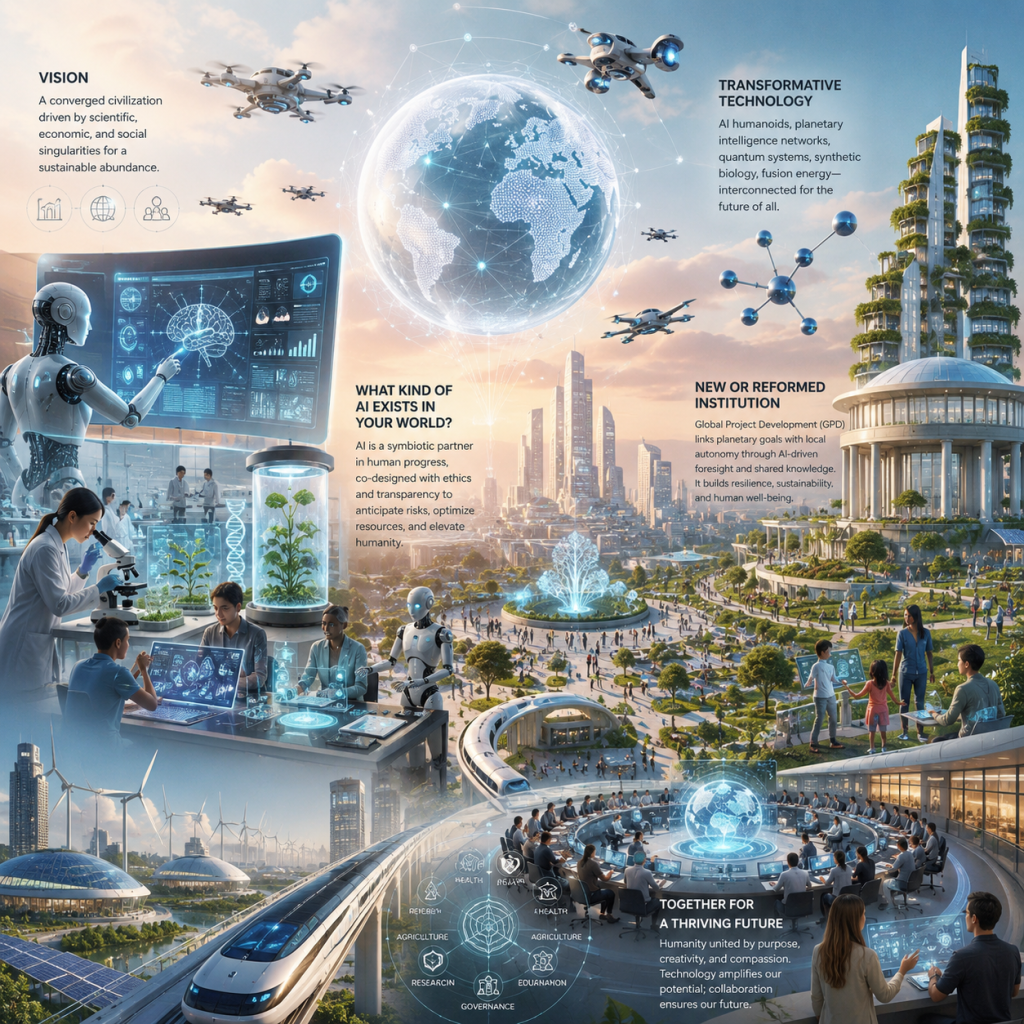
OMNI represents the convergence point of human civilization — where scientific, economic, and social singularities merge into a self-reinforcing ecosystem of abundance. Through coordinated “glocal” megaprojects, humanity transforms global challenges into engines of wealth creation. Climate restoration creates energy singularities, biotechnology creates health singularities, AI creates intelligence and governance singularities, and industries create productivity singularities .
By 2035, technologies no longer operate separately but as a planetary intelligence network. AI coordinates energy, healthcare, agriculture, logistics, governance and education in real time. Quantum computing scientific discovery, synthetic biology restores ecosystems and eliminates diseases.
What kind of AI exists in your world?
In this world, AI coexists in a symbiotic relationship with human institutions. Unlike passive tool AI, these systems anticipate risks, coordinate infrastructure, and optimize resources across cities and nations. AI is developed collectively by governments, universities, citizen cooperatives, and ethical technology alliances rather than monopolized by corporations. Every AI decision remains transparent and auditable, creating trust while enabling humanity to solve problems at planetary scale.
New or Reformed Institution
Glocal Project Development (GPD) — an institution linking planetary coordination with local autonomy. The GRC transforms crises into economic ecosystems by directing capital, talent, and AI-driven forecasting toward emerging challenges. Global networks share breakthroughs instantly, while local communities adapt solutions to their cultural and environmental realities. The institution measures success not only by GDP, but by resilience, sustainability, knowledge creation, and human well-being.
Transformed Sector
Singularities
Singularities
Education : AI mentors provide adaptive lifelong learning for every citizen. Healthcare Predictive bioengineering prevents disease before symptoms emerge. Work : Human labor shifts from survival tasks to innovation, and creativity, . Governance : Real-time participatory systems make institutions transparent and responsive. Food : Vertical farming and synthetic proteins eliminate scarcity. Mobility : Autonomous clean transport turns cities into connected, low-emission
A Major Crisis Overcome
The defining crisis of the early 2030s may be — simultaneous climate shocks, cyber-collapse, pandemics, freshwater shortages, and mass displacement. Unexpected emergencies exposed the fragility of fragmented systems. Humanity survived by building decentralized resilient networks powered by autonomous infrastructure, distributed energy, and cooperative AI governance. The crisis permanently shifted civilization from competitive extraction toward collaborative adaptation and shared prosperity.