Skip to content
  • About
  • Podcast
  • Engage
    • Meme Prize
    • Worldbuilding Course
    • AI Pathways
    • Hyper-Entities
  • About
  • Podcast
  • Engage
    • Meme Prize
    • Worldbuilding Course
    • AI Pathways
    • Hyper-Entities
  • Worldbuilding course
  • Guest lectures
  • Toolbox
  • World gallery
  • World submission
  • Worldbuilding course
  • Guest lectures
  • Toolbox
  • World gallery
  • World submission
  • About
  • Podcast
  • Engage
    • Meme Prize
    • Worldbuilding Course
    • AI Pathways
    • Hyper-Entities
  • About
  • Podcast
  • Engage
    • Meme Prize
    • Worldbuilding Course
    • AI Pathways
    • Hyper-Entities
  • Worldbuilding course
  • Guest lectures
  • Toolbox
  • World gallery
  • World submission
  • Worldbuilding course
  • Guest lectures
  • Toolbox
  • World gallery
  • World submission
X-twitter Bookmark

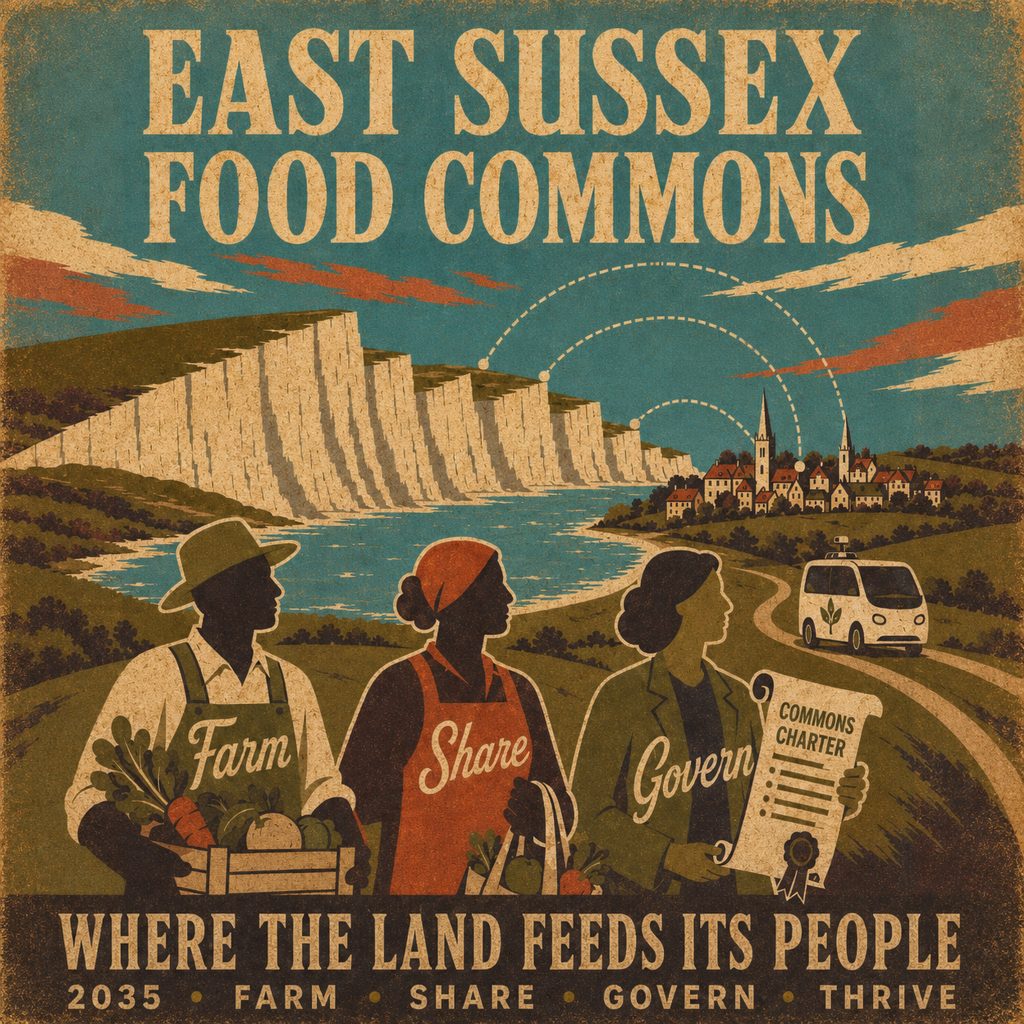
East Sussex Food Commons

Creator Information

Name:

Aaron Taylor Gough

Role:

Casual Academic

Social Media/Website:

Visit

World Summary

Vision

In 2035, East Sussex has built a food commons where AI handles the logistics and a Decentralised Human Organisation made up of farms, charities, and residents directs surplus from field to table, to the people who need it most.

Transformative technology

An AI-powered platform matches farm surplus to community need and routes an autonomous vehicle fleet

Food insecurity, supply chain failure, and a rapidly changing climate created a perfect storm. In 2035, farm surplus reaches the people who need it. Nothing is wasted, no one is turned away, and communities govern their own food resources, enabled by AI and directed by the people within them.

What kind of AI exists in your world?

Tool AI provides powerful infrastructure under human direction. The system operates across three layers: 1) farm-facing classification of surplus; 2) inventory, routing and trend analysis at network level; and 3) autonomous refrigerated fleet management. Built and maintained as a public commons utility by a cooperative of regional technology trusts, accountable to the DHO and its commoners rather than to shareholders or central government.


New or Reformed Institution

A federated food commons governed by a Decentralised Human Organisation – farms, charities, and residents each hold equal governance rights. Operating on commons principles drawn from Ostrom’s design framework, the institution is partially self-financing through its surplus market and materials streams, removing the grant dependency that collapsed previous redistribution networks. Regional commons trade surplus across the country, creating a national network of mutual food resilience.

Transformed Sector

Food

Surplus distribution has shifted from a charity-dependent, fragile system to a self-sustaining commons. Surplus that rotted in fields or landfills now moves through three streams: welfare, open market, and materials, reaching those in need first, compensating farms, and supplying local makers with new materials. The transformation proves that food security is not a production problem, but a distribution and governance problem, solved not by new technology but by reorganising what already exists.

A Major Crisis Overcome

In March 2025, Havens Food Cooperative in Newhaven closed after redistributing over 1.5 million pounds of food – a victim of local authority cuts and funding collapse. Across East Sussex, volunteer-run networks were folding under the same pressure: grant dependency and no sustainable model. The Food Commons answered this not with another grant cycle but with a governance and financing structure that doesn’t require one; a commons that funds itself, governed by the people it serves.

A project by the Foresight Institute

Copyright © 2026. All rights reserved.

ABOUT

Contact & Press

Library

Archive

Privacy Policy

Youtube Spotify Podcast X-twitter