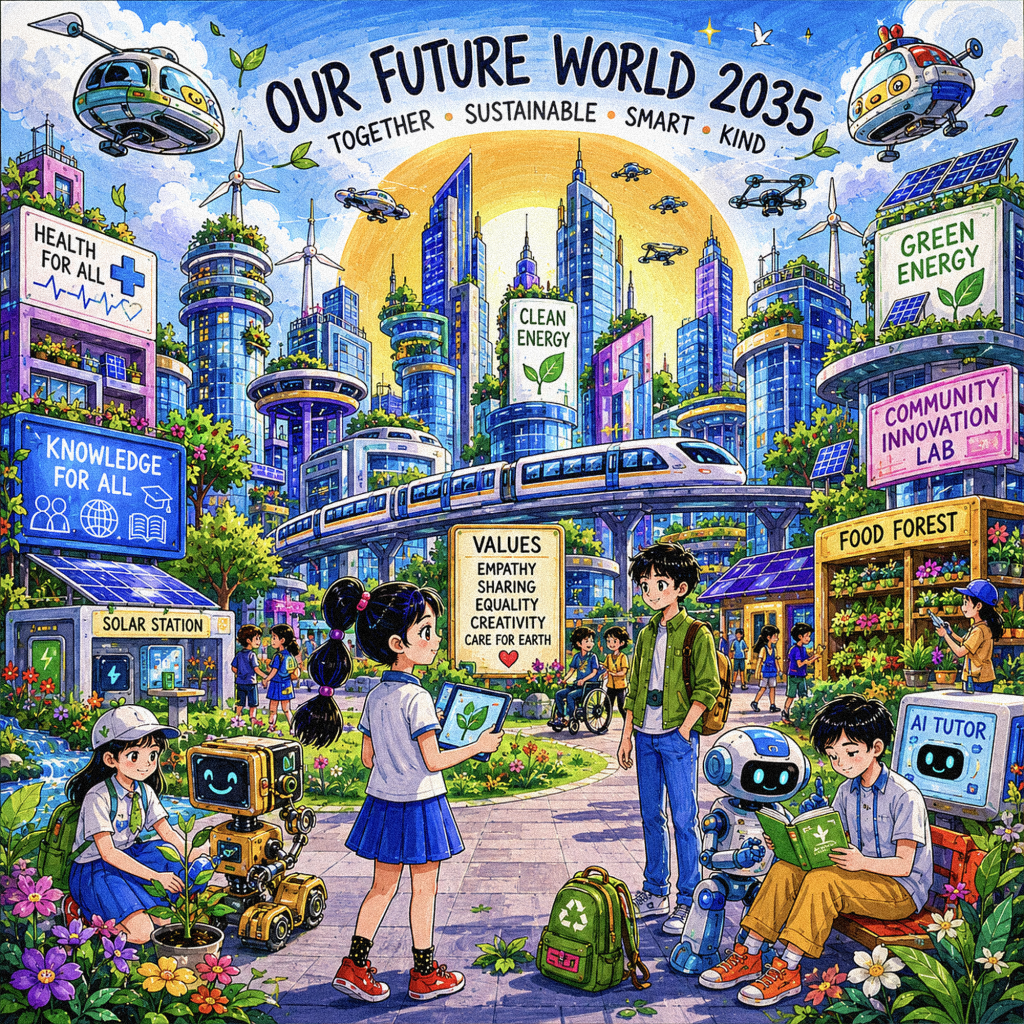
By 2035, cities have become living ecosystems where clean energy, AI, nature, and compassionate communities work together to ensure healthcare, education, and opportunity are accessible to everyone. This future is hopeful because technological progress is guided by empathy and sustainability, creating a world where both people and the planet can thrive together.
Transformative technology
Technology: Autonomous AI Autonomous AI acts as a trusted city-wide partner, independently managing
Autonomous AI solves the challenge of unequal access to essential services, climate change, and inefficient resource management by coordinating energy,healthcare,transportation,education, and food systems in real time. It ensures resources are distributed fairly while reducing waste and environment
What kind of AI exists in your world?
Autonomous AI manages energy, transport, healthcare, education, and environmental systems in real time, solving climate challenges, resource waste, and unequal access to services. Built by researchers, engineers, governments, universities, nonprofits, and local communities, it operates with human oversight to ensure transparency, fairness, and sustainability, creating healthier, greener, and more connected cities by 2035.
New or Reformed Institution
Institution: Global Human–AI Stewardship Council (GHASC)
Purpose: The Global Human–AI Stewardship Council ensures Autonomous AI remains ethical, transparent, and accountable. It establishes global standards, audits AI systems, protects privacy and human rights, and brings together governments, scientists, communities, and nonprofits to ensure AI serves the public good while advancing sustainability, fairness, and human well-being.
Transformed Sector
Urban Governance & Public Services
By 2035, Urban Governance & Public Services have transformed from reactive, fragmented systems into an intelligent, AI-coordinated ecosystem. Autonomous AI continuously manages transportation, clean energy, healthcare, education, emergency services, and environmental protection, predicting community needs before problems arise. Citizens receive faster, personalized, and more accessible public services, while human leaders focus on ethics, policy, and long-term
A Major Crisis Overcome
Major Crisis Overcome:
By the late 2020s, the world faced escalating climate disasters, resource shortages, and widening social inequality, overwhelming traditional systems. Humanity overcame this crisis by adopting Autonomous AI governed by strong ethical institutions, enabling real-time coordination of clean energy, healthcare, food, transportation, and environmental restoration—creating resilient, sustainable, and inclusive communities by 2035.