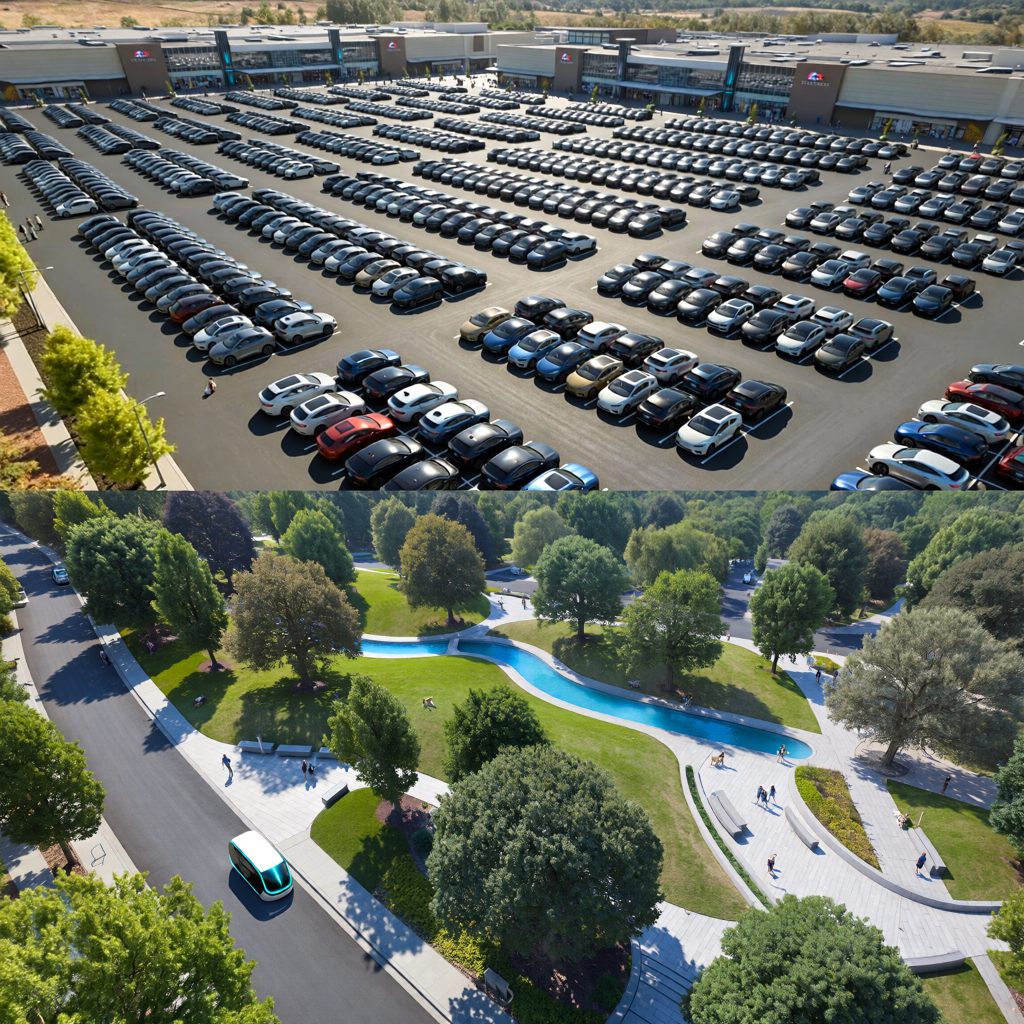
In 2035, there are no “traditional” cars. Instead, everyone has access to ubiquitous, affordable, high-tech transportation. This is hopeful because robotaxis have sparked a revolution so profound that it has eclipsed the invention of the automobile itself.
Transformative technology
Autonomous Mobility
Autonomous mobility has broken the vicious cycle in which rising prosperity once led to more private cars, and more cars led to greater congestion, environmental pressure, and the loss of valuable urban space. We’ve managed to neutralize one of the “Four Horsemen” driving the climate apocalypse.
What kind of AI exists in your world?
In 2035, we have HAIve—an intelligence built from AI and the logic of a hive. It is both a “super-driver” and a “super-city”: a collective autonomous mobility system in which vehicles, infrastructure, and the city itself constantly communicate and learn from one another.
HAIve can effectively “see around corners” and prevent collisions before they happen. This is not only because of powerful edge AI but also because architects have introduced new spatial elements and “autonomous” design.
New or Reformed Institution
American Architectural School
Purpose: To educate the architects and urbanists who design cities for the autonomous era.
Until the mid-2020s, American architecture schools largely ignored autonomous mobility, preferring familiar “sustainable” solutions such as bike lanes and walkable streets. But the rapid rise of robotaxis—and the efforts of a growing group of visionary architects and researchers—finally made the scale of the transformation impossible to ignore.
Transformed Sector
Transportation
By 2035, 80–90% of passenger travel and a significant share of freight transportation operate under a Transport-as-a-Service model powered by autonomous electric vehicles.
In the passenger segment, access to autonomous transportation has become a basic necessity. Why? Because robotaxis have not simply transformed the transportation sector—they have become a catalyst for change across other sectors, including housing. Total household savings have approached $1 trillion.
A Major Crisis Overcome
The greatest crisis we overcame was the crisis of automobile overproduction.
Until recently, the transportation industry had begun to resemble a crazy competition between mega-corporations trying to outproduce one another—to “outmillion” their competitors, as if sheer numbers could determine the “winner.”
It is frightening to imagine how quickly we were accelerating toward both a social and a climate catastrophe while operating within that logic.