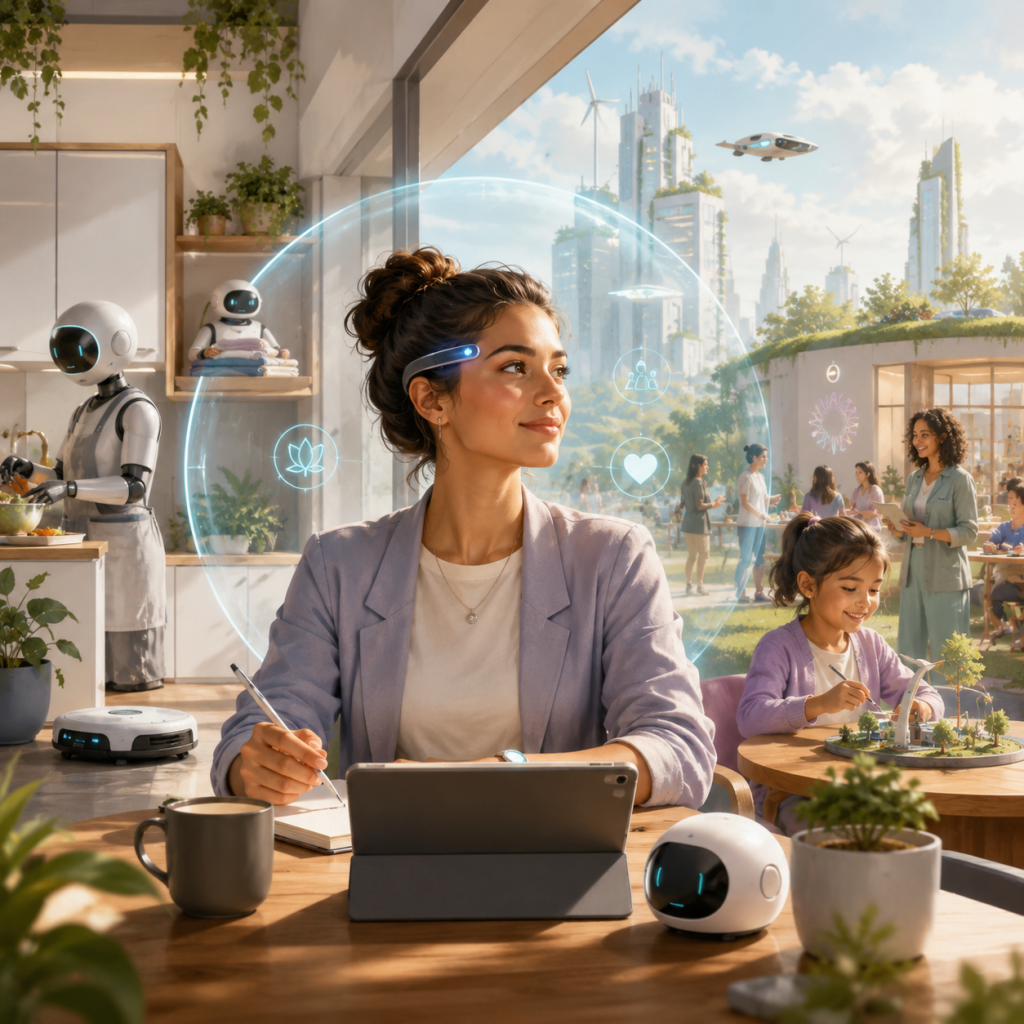
In 2035, people, and especially women, who spent hours on invisible and unpaid job at home are now in public life — founding companies, teaching children, making decisions. Their children are the first since the smartphone era to grow up with their attention their own. Two technologies changed daily life: AI assistants doing the cooking, the scheduling, and the household management, and personal mind protective equipment filtering the noise that had made it hard to think.
Transformative technology
Personal mind protection technology for attention control
A three-layer system: a wearable that reads stress and attention signals, a device filter that screens algorithmic manipulation before it reaches you, and a home environment tuned for focus and rest. By 2035, over a third of Finnish households run it — subsidised as public health infrastructure.
What kind of AI exists in your world?
AI assistant helps Lia do laundry on Mondays. By the time her daughter wakes up, lunches are made and floors are clean. It does groceries to. Lia used those hours to build a company. Her neighbour used them to finish her degree. The woman downstairs used them to sleep. This AI does not have opinions about your choices. It does not learn your patterns in order to sell them. It gives you more hours to live.
New or Reformed Institution
FreeMindRoots cooperative
On Tuesdays, Lia’s daughter takes the tram to a low building near the park with mud tracked across the entrance and drawings covering every wall. She stays four hours. She comes home having debated about something, made something with her hands, and sat outside doing nothing at all. She calls it the place where nobody rushes her. FreeMindRoots cooperative started in 2031 with fourteen parents in a Helsinki basement who were all, quietly, frightened by the same thing.
Transformed Sector
Education
In 2030, a study found that children could no longer sustain twenty minutes of unassisted thought. Lia had known for two years after having her child. By 2035, a child’s week includes a community learning hub, time outdoors, and a peer learning, with children having their thought still their own.
A Major Crisis Overcome
By 2028, burnout clinics in Finland had waiting lists six months long. Women’s workforce participation had slipped for three years running. Schools were graduating students who could scroll through anything and sit with nothing. Yet within a decade, mind protection moved from a startup to a public health programme, domestic AI shifted from a luxury to a household standard, and parent-led cooperatives rebuilt how children learn. Finland got there first.