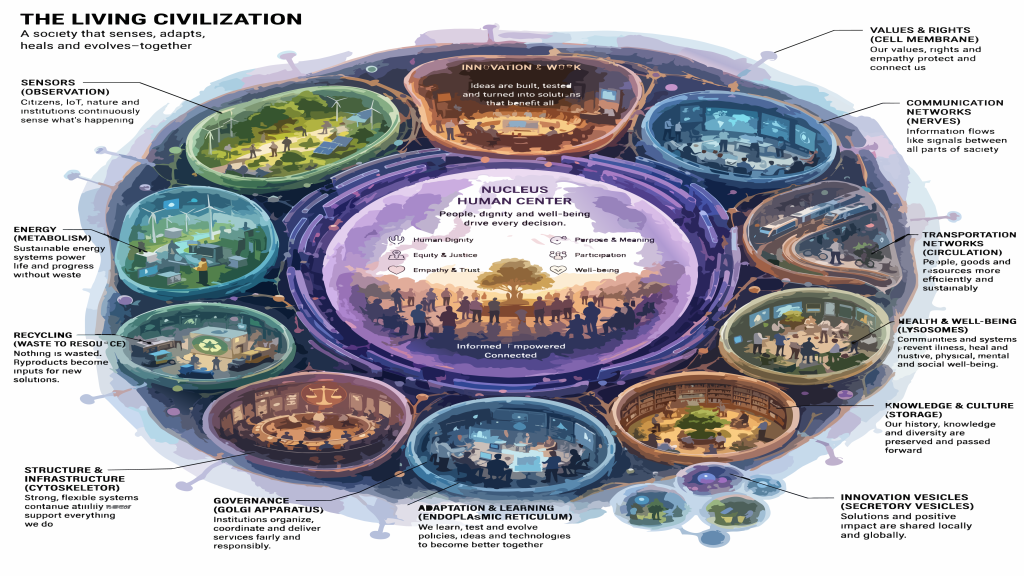
In 2035, humanity’s greatest breakthrough wasn’t creating a smarter AI—it was learning how living systems survive. Civilization adopted biology’s principles of sensing, adaptation, regeneration, and cooperation, becoming a self-healing society where every person, institution, and ecosystem strengthens the whole instead of competing against it.
Transformative technology
The Living Network
The Living Network is a planetary intelligence layer connecting people, public infrastructure, ecosystems, and scientific knowledge. Like a nervous system, it continuously senses change, predicts risks, and shares solutions, allowing civilization to adapt before local problems become global crises.
What kind of AI exists in your world?
AI forms the nervous system of civilization rather than replacing it. Built as transparent public infrastructure by governments, universities, communities, and open-source researchers, AI continuously connects observations from billions of people, sensors, and institutions. It helps society understand itself, simulate future decisions, and coordinate action, while humans remain responsible for values, ethics, and governance.
New or Reformed Institution
The Council for Civilizational Health
Instead of measuring success primarily through economic growth, the Council measures the health of civilization itself—its resilience, public trust, biodiversity, knowledge flow, and capacity to recover from disruption. Before major policies are introduced, they are tested through large-scale simulations to ensure society evolves through learning rather than crisis.
Transformed Sector
Civilizational Infrastructure
Infrastructure now includes more than roads and power grids. It encompasses the living systems that keep civilization healthy: knowledge, healthcare, governance, ecosystems, education, and communities. Every part continuously senses, communicates, and adapts, allowing cities to repair themselves, institutions to learn together, and local discoveries to strengthen humanity as a whole.
A Major Crisis Overcome
During 2020-30, humanity faced overlapping climate disaster, pandemics, infrastructure failures, misinformation, and collapsing public trust. The crisis revealed that the problem was not a lack of intelligence but a lack of connection between systems. By redesigning civilization around the biological principles of cooperation, adaptation, and regeneration, humanity transformed fragmented institutions into a resilient living network capable of preventing crises instead of merely reacting to them.