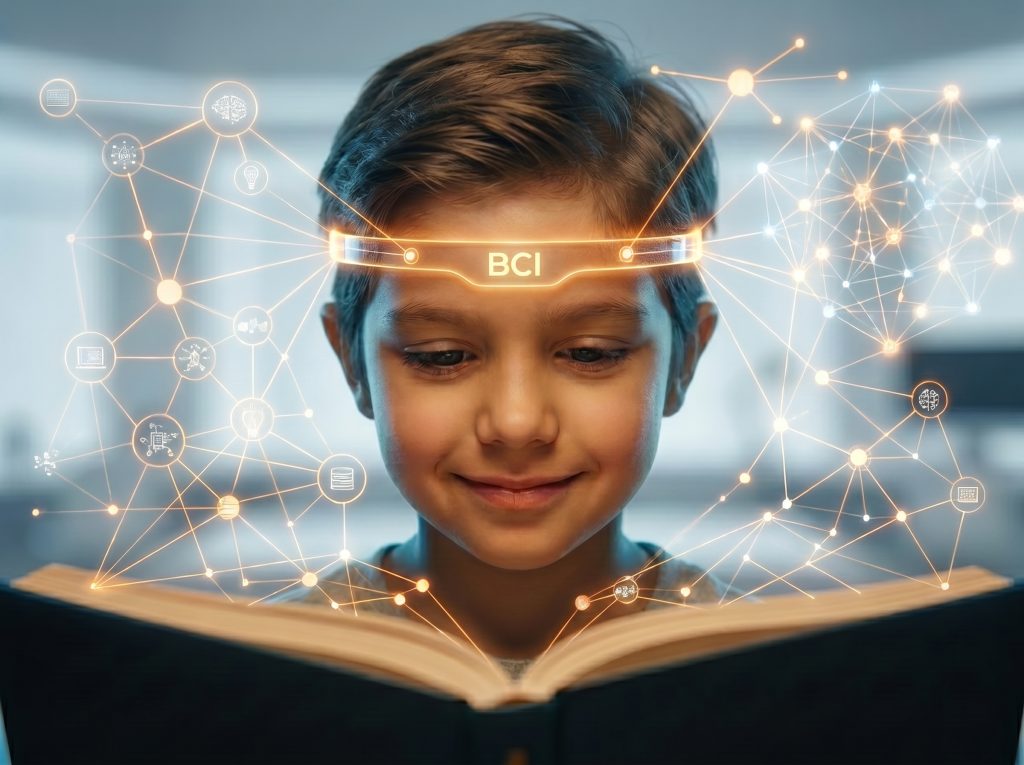
By 2035, the same intelligence that displaced millions of workers becomes the tutor that helps everyone learn again. Tiny, private, on-device companions read a learner’s attention and confusion directly — the way a great human tutor reads a face — and meet every child and every re-skilling adult exactly at their edge. The one-on-one tutoring that once only the wealthy could buy is now a shared commons: free, global, and private by design. It rebuilds not just skills but the joy of effort.
A passive brain-computer interface reads attention and confusion with no conscious command — software finally gets a tutor’s eyes. Neuromorphic chips run it on-device for a few dollars and near-zero power, so neural data never leaves the tablet: a great private tutor, affordable for everyone.
What kind of AI exists in your world?
Tool AI, not autonomous — a personal learning companion that runs entirely on your own device and learns only you. It finds your zone of proximal development, paces lessons to your live attention, and coaches grit so effort itself becomes rewarding. It works for kids and re-skilling adults alike. First built by competing corporations as closed products, it was later forced open — public pressure turned the core into shared, open-source infrastructure owned by no one.
New or Reformed Institution
The Global Learning Commons — a public trust backed by an intergovernmental treaty. Its charter does two jobs. First, it guarantees cognitive liberty: neural data must stay on the user’s device by law, and may never be sold, exported, or used for profiling — a child’s mind is not a market. Second, it keeps the core tutor open-source, free, and translated into every language, and funds distribution so access never tracks a family’s wealth or a country’s GDP. Watchdog NGOs keep it honest.
Transformed Sector
Education
Education stopped sorting children and started meeting them. The old classroom taught thirty kids one lesson at one pace and lost whoever fell behind. Now learning bends to the learner: the tutor sees confusion instantly and adjusts. A curious kid with ADHD, written off as distractible, finally gets material paced to how their attention actually moves. Teachers become mentors, not crowd-controllers. Free and global, it no longer matters where a child is born.
A Major Crisis Overcome
Two crises collided. Automation hollowed out knowledge work faster than people could re-skill — while an attention economy of endless feeds, five-second reels and AI slop quietly starved the focus that learning depends on. Curious kids couldn’t sustain attention; adults couldn’t retrain fast enough. The answer wasn’t blaming people — it was rebuilding attention like a muscle. On-device tutors made personal re-skilling cheap and private, and public pressure forced it open and free.