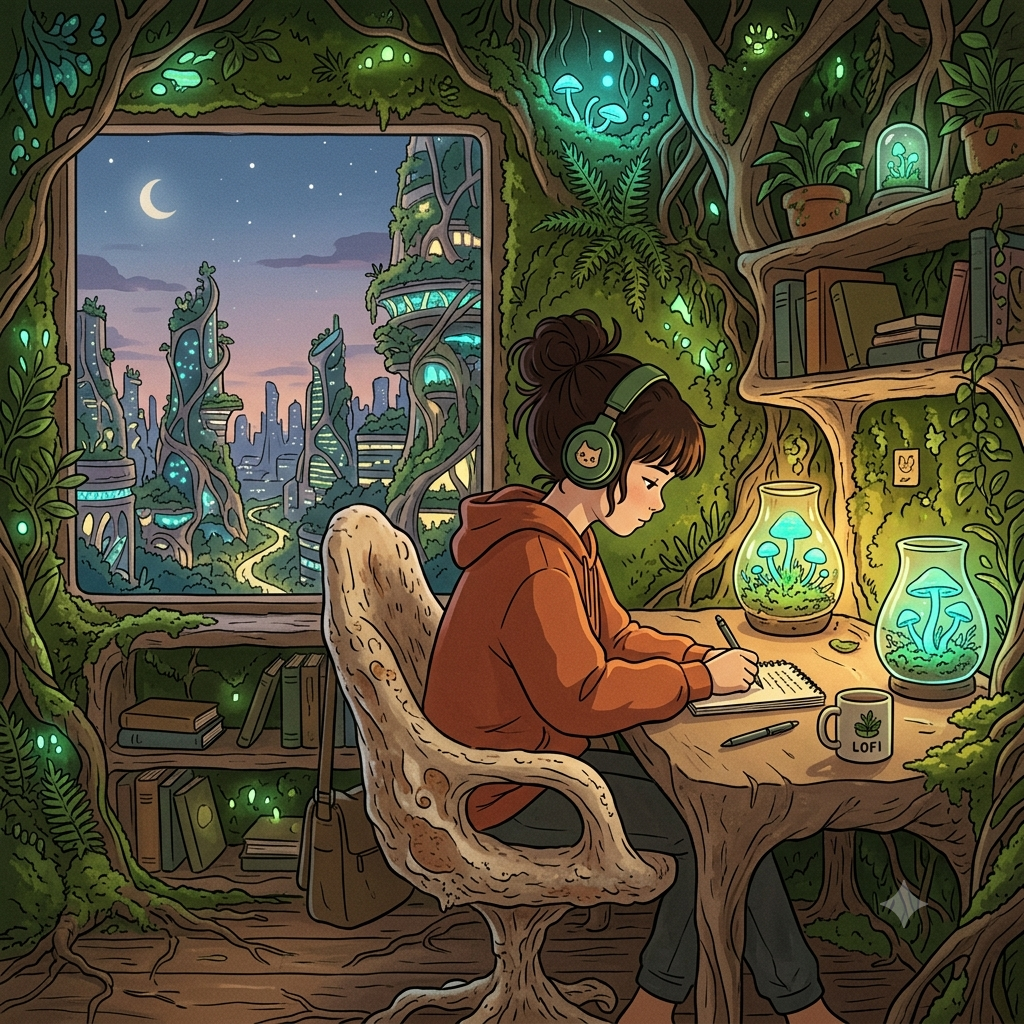
We spend most of our lives inside buildings, but we have almost no say in how they are made. They’re usually built by massive developers using unsustainable materials, and often look soulless and generic. On top of that, many young people fear they will never afford a home. I hope for a future where AI lets us design our own living spaces and use local biofoundries to grow sustainable materials that allow for easy construction from modular parts.
Transformative technology
Biomaterial Science
In 2026, around 40% of global emissions come from the construction industry. The housing crisis affects more and more people, especially GenZ. In 2035, local biofoundries grow affordable building materials from fungi and cyanobacteria and homes actively sequester CO2, capturing legacy carbon.
What kind of AI exists in your world?
Tool AI now translates human ideas into structurally sound building blueprints and bioengineering plans. Knowledge workers adapted by becoming designers paid for the aesthetic taste AI still struggles with, or by running biofoundries. While premium AI access remains unequal, open-source models made by academics and tinkerers allow regular citizens to design their own affordable homes. AI handles the complex math and biology, while humans focus on aesthetics, wellbeing, and community needs.
New or Reformed Institution
The Bioarchitecture Security Agency was formed as housing shifted from built to grown. It prevents bioterrorism by managing the open-source genomic and AI blueprint libraries. Despite being a body responsible for certifying biofoundries, it’s not an institution used as means of survaillence and control. Instead, BASA standardizes biomaterials to work in any climate so that people can benefit globally. It also tests them to ensure grown buildings don’t trigger allergies.
Transformed Sector
Construction and architecture
By 2035 architecture feels more like applied ecology. The line between urban and rural has blurred, since building surfaces now can be used to grow food, freeing crop field space to house more people. Walls purify air and can glow in the dark to cut down on electricity. Societally this matters because it transforms housing as a source of emissions and anxiety into a medium of artistic expression centered around planetary and human health.
A Major Crisis Overcome
Due to climate change and extreme weather, millions lost their homes in the late 2020s. Tornadoes and earthquakes wiped out cities, and coastal towns disappeared in floods. We overcame this by using AI and biotech to ensure houses are easily constructed (modularity), their building blocks can be grown locally (decentralization), and they can self-heal (regenerative biomaterials) after damage. We also started to reverse climate change by turning our homes into carbon sinks.