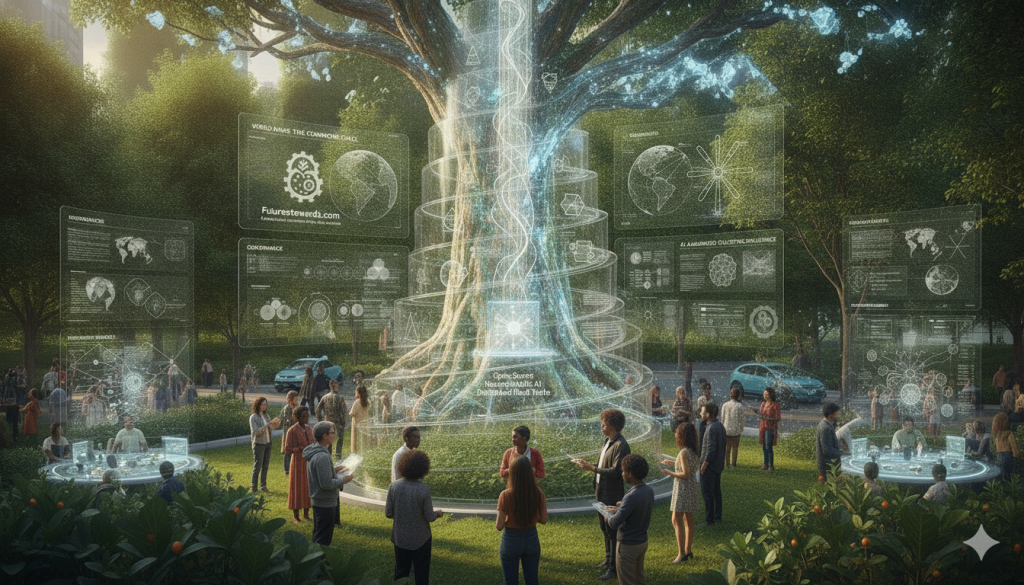
By 2035, an open-source AI stack on a distributed hash table rendered Earth’s living systems legible — to machines and to people. The twelve domains of civilisation run on transparent, democratically governed infrastructure. Technology finally pays its (long overdue) debts to ecology.
Transformative technology
Open-source neurosymbolic AI stack for the physical economy, running on a distributed hash table
Category theory as substrate, complete graphs as structure, systematics as semantic and syntactical form — an k8 graph articulates eight dependencies: sensing, data rights, geospatial representation, open models, domain evals, workflow deployment, distributed compute, natural capital markets.
What kind of AI exists in your world?
Neurosymbolic AI — largely autonomous in execution, intent-responsive: humans set values and goals, the stack acts within their structured frame. Built on open geospatial, forecasting, and climate models, it coordinates across eight layers without constant human instruction. No single corporation controls the stack. The system is teleozetic: purposive toward human-defined ends, transparent in reasoning, and auditable at every layer. Autonomy earns trust through legibility.
New or Reformed Institution
Futurestewards.com — a regenerative commons for the third horizon, stewarding the Commons Stack’s identity, purpose, and intention through democratic facilitation. It holds the neurosymbolic IP, ensuring integrity so that assets remain in the commons and not a corporate asset. Where machines handle physical legibility, Futurestewards develops human governance literacy — training policymakers, organisers, and commons stewards in collective intelligence and values-aligned AI deployment.
Transformed Sector
Governance
By 2035, governance escaped path dependency through AI-augmented collective intelligence. Digital democracy tools — citizen assemblies, consensus-mapping platforms, adaptive policy frameworks — replaced institutional inertia with real-time responsiveness. AI detects crises, models outcomes, and surfaces dissenting voices before marginalisation. Power remains human: AI informs, never decides. The result is governance that evolves with the world rather than lagging a decade behind.
A Major Crisis Overcome
AI capability concentrated in a few tech corporations threatened to make the AI transition as unequal as the industrial revolution. The physical economy — agriculture, energy, infrastructure — was being left behind, deepening the gap between knowledge workers and everyone else. The open-source movement responded: shared benchmarks, open geospatial models, and transparent data rights turned the physical world legible to machines — and kept those machines accountable to communities.