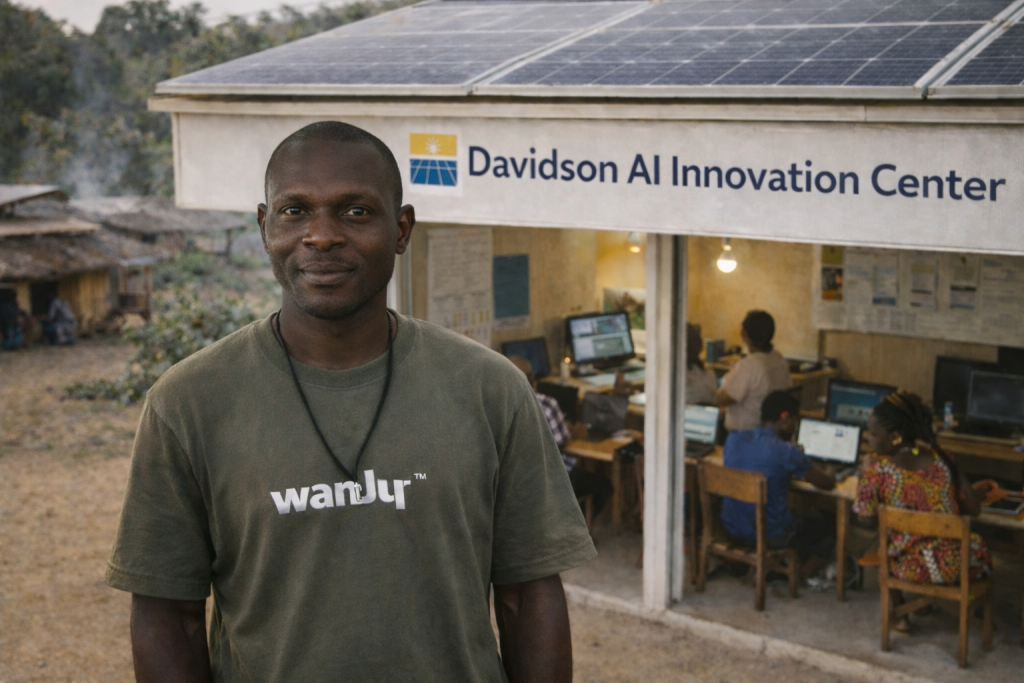
In 2035, the world’s most energy-poor communities are also its fastest-learning ones — because AI arrived before the grid did. NextVillage proved that human capability, not infrastructure, is the true prerequisite for development, and that a village in the Niger Delta could teach the world how to learn.

It solved the “PUE gap” — the absence of productive human capacity that makes rural electrification fail. By 2035, AI tutors operate on solar microgrids, delivering literacy, vocational skills, and critical thinking before the power lines arrive, reversing decades of top-down development logic.
Primarily Tool AI — community-directed, not autonomous. AI tutors are built and governed locally through village-level AI Innovation Centers (vAI). Communities own their data and shape what gets taught. AI serves cultural knowledge, not the reverse. No black-box systems; every learner can interrogate what the AI knows and doesn’t.
The Village AI Innovation Center (vAI) — A community-anchored hub where peer teachers (many starting from zero literacy) become certified AI practitioners and curriculum co-creators. vAI centers replace the “expert from outside” model with one where local knowledge holders are the architects of their own learning futures.
By 2035, learning is no longer downstream of electricity, roads, or institutions. Solar-AI hubs have decoupled capability formation from infrastructure access. Peer teachers trained in places like Oloibiri, Nigeria now consult globally. The “last mile” became the leading edge — redefining who gets to be an expert and where transformation begins.
Energy poverty was never just a hardware problem — it was a capability problem. Communities received solar panels and generators but lacked the skills to use them productively. NextVillage confronted this by treating AI-facilitated learning as a prerequisite for energy deployment, not an afterthought. By 2035, the “productive use gap” is understood globally as the real barrier — and village-built AI centers are the proven solution.