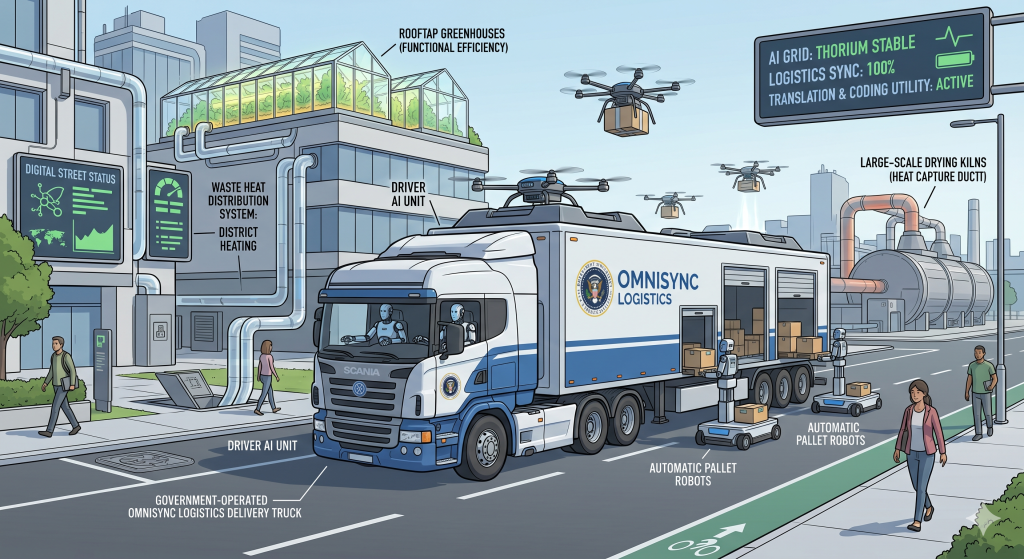
I envision a hyper-connected future where conversational AI empowers anyone to effortlessly code their ideas and dissolves global language barriers in real-time. This world is hopeful because autonomous systems seamlessly optimize our logistics, from transit to zero-waste food distribution – freeing humanity to focus on community and creativity.
Drone delivery trucks are autonomous semis utilizing aerial drones, pallet bots, and humanoid drivers for complete end-to-end transport. They solve supply bottlenecks via 24/7 operation, creating a near-zero-waste global network that ensures almost immediate, universal access to resources.

Image and video generation were phased out due to cost, leaving pure LLMs. For the layman, AI is a cheap translation, coding, and research tool; personal use is financially offset by massive business contracts that use AI to automate global logistics. Following the 2026 US intervention with Anthropic’s Claude Fable and Mythos, AI is a government-managed utility monopoly (like an ISP). The state strictly controls access rights, sets pricing, and subsidizes the infrastructure with tax dollars.
The DOAII (Department of Artificial Intelligence Infrastructure) oversees the national AI grid. This agency solved the compute energy crisis by integrating server farms directly into public infrastructure. Data centers run on dedicated thorium reactors, while the massive waste heat generated by the LLMs is piped as direct thermal energy into municipal greenhouses, district heating, and industrial drying kilns. It ensures seamless coding access without taxing the public power grid.
Traditional software engineering was eradicated when coding became a basic translation task. By 2035, memorizing syntax is obsolete because the state-run LLM is capable of translating natural human language directly into functional code almost perfectly. The career of the software engineer dissolved, simply replaced by normal people. Anyone can now build apps, modify digital environments, or automate tasks simply by stating their functional intent, allowing for advanced digital creation for all.
In 2027, the AI bubble burst as extreme compute costs and grid failures bankrupted the private sector. Facing total logistical collapse, the US government nationalized the industry. This sparked fierce political battles over energy consumption and taxpayer burden. Fortunately, simultaneous breakthroughs in commercial thorium reactors provided a sound solution. By migrating now state-owned LLMs to decentralized thorium grids, the US stabilized the system, creating a sustainable public utility.