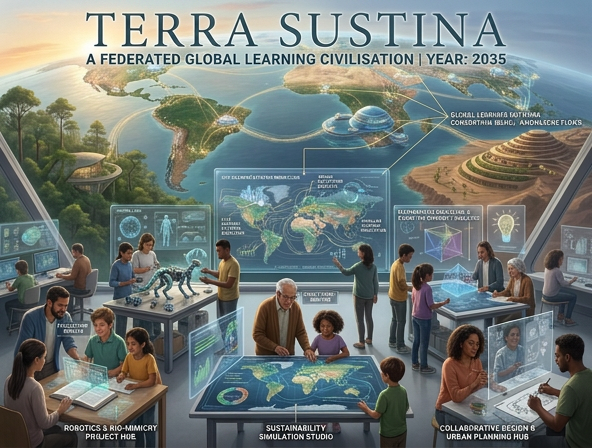
A future where education becomes a lifelong, adaptive ecosystem supported by AI as public infrastructure, enabling people to learn in ways aligned with their cognitive diversity, context, and potential while contributing to a sustainable world. Rigid, standardised systems are replaced by a federated global learning network that integrates knowledge, ethics, and systems thinking into everyday life, making education more inclusive, resilient, and responsive to global complexity.

AI-enabled adaptive education personalises learning and assessment using competency-based, AI-supported pathways, while sustainability modelling tools simulate real-world systems like climate, economy, and migration, integrating subjects into interconnected, systems-based learning.
AI in this world exists primarily as Tool AI under human governance, embedded as infrastructure across education, public services, and knowledge systems rather than operating as an independent decision-making authority. It supports learning, adaptation, and accessibility rather than defining goals or values. In education, as a personalisation engine adapting learning to cognitive profiles, a simulation environment for systems thinking, and an accessibility layer for neurodivergent.
The Global Learning Network Consortium (GLNC) is a federated international institution that connects national education systems without centralising control. It acts as a coordination and standards body. Its purpose is to ensure interoperability between systems while preserving local autonomy. It sets shared frameworks for competency-based learning, sustainability literacy, systems thinking, and ethical AI use.
The education sector has become a distributed, lifelong learning ecosystem rather than a fixed stage of life, integrating learning, work, and community participation. Schools and universities operate as learning hubs within wider networks, combining specialised facilities with AI-supported learning at home and in communities. Learning is competency-based rather than age-based, with continuous assessment through projects, problem-solving, and mentor evaluation.
AI-driven automation and climate pressures in the late 2020s and early 2030s exposed the limits of traditional education systems and increased inequality in access to reskilling and opportunity. Governments responded by treating education as public infrastructure, shifting to federated, AI-supported, competency-based systems with personalised learning and continuous assessment. By 2035, these changes improved adaptability and reduced inequality, though uneven access still remained.