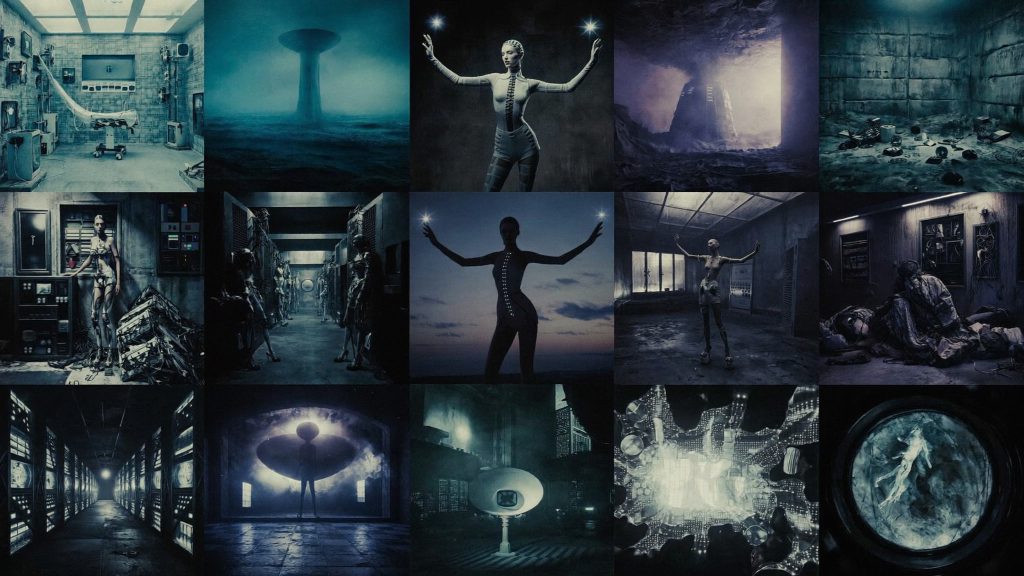
By 2035, collective consciousness infrastructure — built on the neurological equivalence of Buddhist chanting, rave music, and AI-generated moving image — has replaced algorithmic attention economies with embodied presence networks. Creative agency is no longer extracted from communities but returned to them, with Eastern philosophy and sonic culture providing the governance logic for a post-extractive AI world.
Transformative technology
Neuroadaptive Resonance Systems — biofeedback AI that reads collective somatic states in real time
AI once optimised for individual engagement, deepening isolation. Biofeedback AI reads crowd breath, movement, and neural coherence to generate live soundscapes synchronising collective nervous systems in real time. The rave becomes public infrastructure — gatherings are sites of co-regulation.
What kind of AI exists in your world?
AI is a collective instrument, not an autonomous agent. In 2035, systems are built by artist-researcher guilds under Community Cultural Data Trusts — training data is community-owned, not extracted. AI reads, reflects, and amplifies collective somatic states rather than optimising individual behaviour. No AI holds decision-making power over human lives. Governance is sonic and embodied — shaped by rave culture’s ethics of shared floor, shared risk, shared presence.
New or Reformed Institution
The Consciousness Commons — a decentralised network of artist-run cultural data trusts across post-industrial cities. Purpose: AI systems trained on cultural expression — music, moving image, ritual, language — must be governed by the communities who created them. Inspired by guild models and Eastern commons philosophy, it issues cultural sovereignty agreements, returns training revenue to origin communities, and funds live performance as a public health intervention.
Transformed Sector
Culture / Creative Economy
By 2035, culture is no longer a content pipeline. Artists hold data sovereignty through Cultural Data Trusts; AI tools are licensed, not extracted. Live performance — rave, ritual, concert — is reclassified as preventive mental health infrastructure and publicly funded accordingly. When AI amplifies rather than replaces human expression, culture becomes a site of collective healing. The creative sector’s transformation is proof that an ethical AI world must be built from embodied experience.
A Major Crisis Overcome
The Attention Collapse of the late 2020s — algorithmic addiction, creative precarity, and AI displacement peaking simultaneously — catalysed the Consciousness Commons. When generative AI flooded markets in 2027–28, a global Creative Commons Strike refused further training data without governance rights. This forced Cultural Data Trust legislation across the EU, then globally. What nearly destroyed the creative sector became the mandate for its most radical, most equitable reinvention.