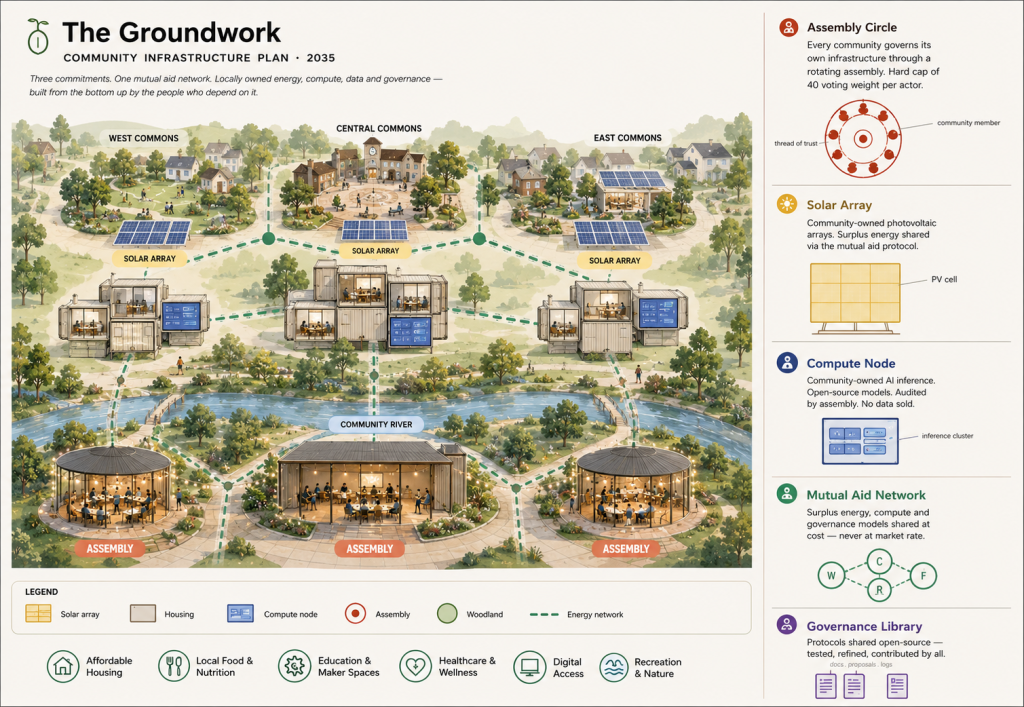
In 2035, communities across the world are building their own sovereign infrastructure stacks — locally owned energy, compute, and data — and governing them through assemblies that are slowly, materially reshaping democracy from the bottom up. The hope is structural, not idealistic: when people own what they depend on together, they learn how to decide together, and that capacity radiates outward into every institution it touches.
Transformative technology
Community-owned AI inference nodes paired with solar microgrids
For too long, AI’s benefits followed existing infrastructure. By 2035, community-owned solar microgrids power local AI inference nodes governed by assembly vote. The community decides what the AI does. Surplus energy and compute flow peer-to-peer at cost. Ownership replaces access.
What kind of AI exists in your world?
Tool AI: Powerful, under human direction, and deliberately kept that way. AI in The Groundwork is a public utility: it optimises energy grids, supports assembly deliberations with data modelling, and helps communities simulate the consequences of decisions before they make them. It is built by community cooperatives and the shared blueprint library, audited openly, and designed to be reversible. No autonomous agents. No synthetic governance. The real intelligence is human and deeply local.
New or Reformed Institution
The Groundwork Assembly — a locally governed body with a hard cap of 4% voting weight per household, firm, or institution, making structural capture mathematically difficult. All consequential decisions require a full community vote. Governance models are shared across a peer-to-peer mutual aid network as open-source protocols, refined through practice across hundreds of communities worldwide. Ownership without governance is just slower dependency. The Assembly makes ownership real.
Transformed Sector
Governance and democratic participation
Governance is no longer something that happens to people between elections. Communities that have built and run their own infrastructure for five or more years arrive at municipal councils and national institutions as organised, experienced actors with data, with legitimacy, and with leverage. The Groundwork does not replace existing democracy; it feeds into it and gradually changes the terms on which citizens engage with it. Participation has become a practiced skill, not a periodic act.
A Major Crisis Overcome
Automation displaced knowledge work. AI’s gains flowed only to those who already owned infrastructure. Democracy hollowed out. The answer was not a policy or a protest — it was a practice. Communities that built infrastructure together discovered they could govern together. That discovery spread community by community through a mutual aid network that treated governance the same way it treated energy: something you share.