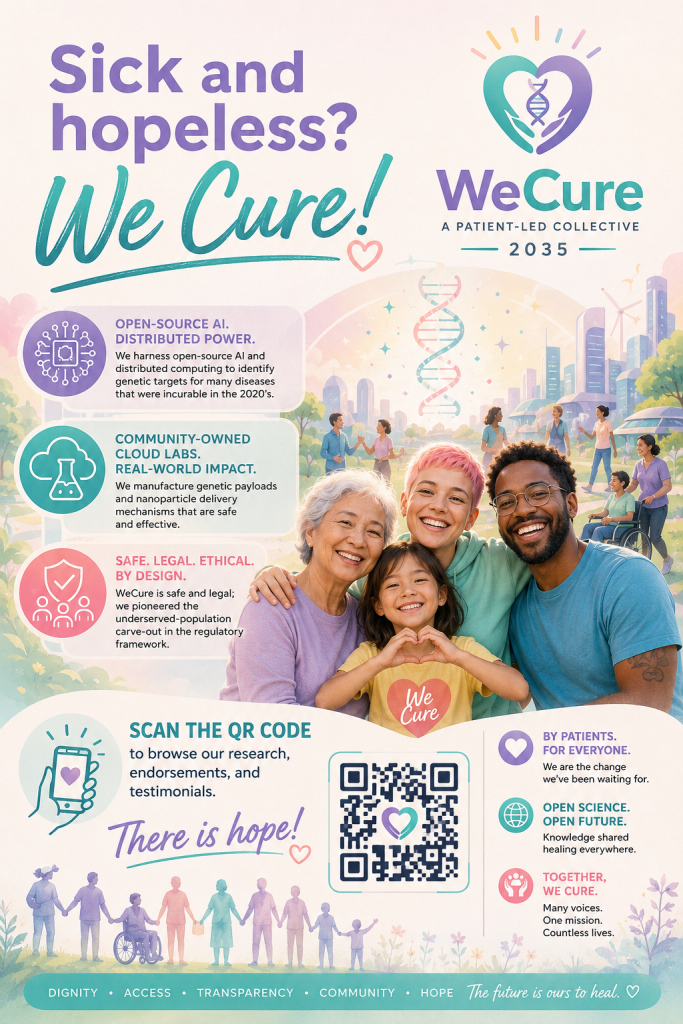
Patient-driven collectives share AI, distributed computation, and community-owned cloud labs to design and manufacture genetic cures for previously incurable conditions. Integrated regulatory lobbying and medical advisory board ensures all treatments are safe and legal. All patients now have hope, no matter how rare or personal their condition is.
Transformative technology
Cloud labs: biomedical wet labs with internet-connected APIs
Cloud labs change the economics of biomedical manufacturing because many people can access shared equipment for different purposes. Expensive equipment is optimized for running any custom procedure according to a programmable API, rather than manufacturing a single molecule at high volume.
What kind of AI exists in your world?
Open-source Tool AI is built by patient-led collectives to perform state-of-the-art genetic treatment design without the distraction and risk of general-purpose AI. The economics of inference is solved by running the AI on distributed networks of consumer hardware.
New or Reformed Institution
Medical regulatory bodies recognized that profit-maximizing single-molecule-for-everyone big pharma was a bad match for the era of personalized genetic treatment. They agreed to adopt a streamlined approval process for distributed design and manufacture of personalized genetic cures that industry wasn’t serving.
Transformed Sector
Medicine
Open-source AI and community-owned cloud labs allow biomedical treatment design and manufacturing outside of corporate structures. This makes it possible to manufacture personalized genetic cures that wouldn’t be profitable enough for profit-driven industry to serve.
A Major Crisis Overcome
By 2030, tensions reached a breaking point between big pharma and desperate patients. Industry-captured regulatory bodies were unable to mediate the dispute until patient collectives won carve-outs in regulatory frameworks. A new category of treatment used approved design and manufacturing processes from accredited sources, without the need to approve every personalized cure for every patient. Safety regulations became more flexible so patients could decide how much risk they could tolerate.